When Motion Meets Meaning
Australia’s Next Top Designer winner Pat Flanagan on engineering calm through kinetic design
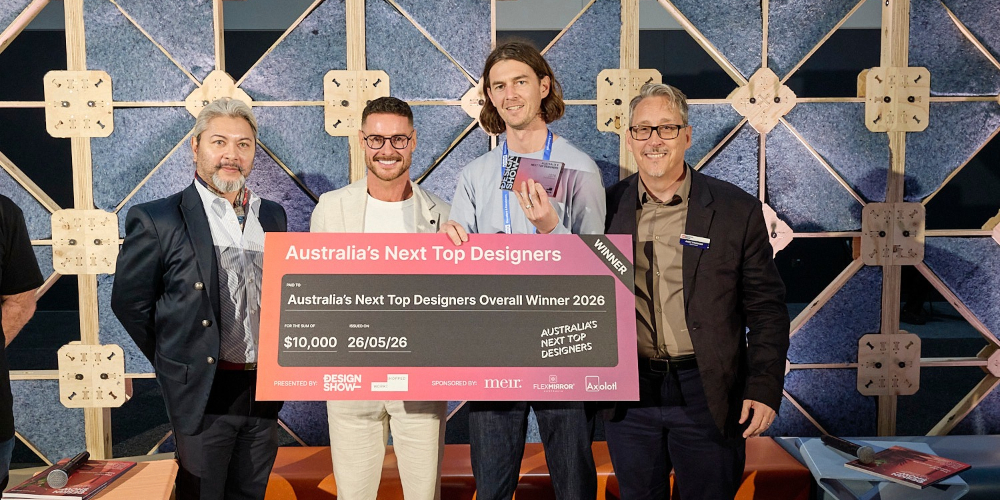
When Pat Flanagan unveiled Spun Through My Mind at this year’s Design Show Australia, he wasn’t simply presenting an object – he was inviting people to experience a feeling.
The mesmerising kinetic sculpture, which earned him the title of Australia’s Next Top Designer (ANTD) 2026, captivated judges and visitors alike with its graceful movement and quiet elegance. More than an impressive feat of engineering, the piece demonstrated how thoughtful design can influence emotion, transforming movement into a sense of calm.
His winning piece evolved from an earlier large-scale sculpture called Orb, which he had exhibited at music festivals and public events. While audiences admired its craftsmanship, it was their emotional response that stayed with him.
That observation sparked a new challenge: how could he recreate that feeling in an object suitable for everyday interiors? “I wanted to bring that calmness into people’s living rooms, hallways and offices. The movement from Spun Through My Mind does that,” he explains.
The result is a beautifully balanced kinetic artwork that bridges sculpture and interior design, proving that movement can become as much a design element as colour, texture or form. While the finished piece appears effortless, achieving that simplicity required a deep understanding of materials and engineering. Pat’s background as a fitter and turner has been instrumental in developing his practice, allowing him to approach each design with equal parts creativity and technical precision.
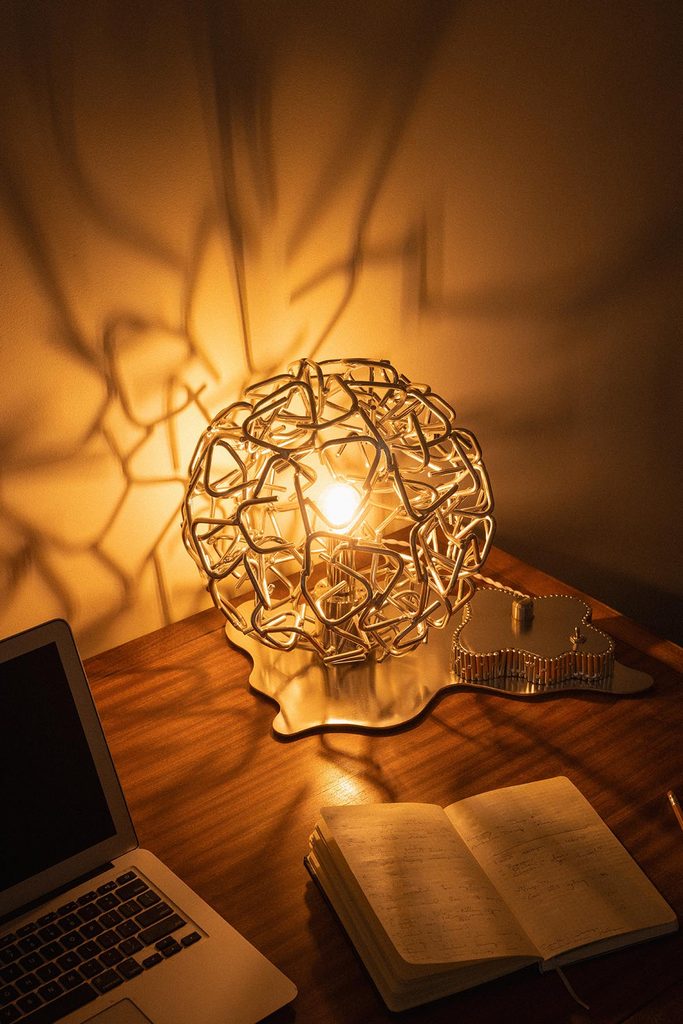
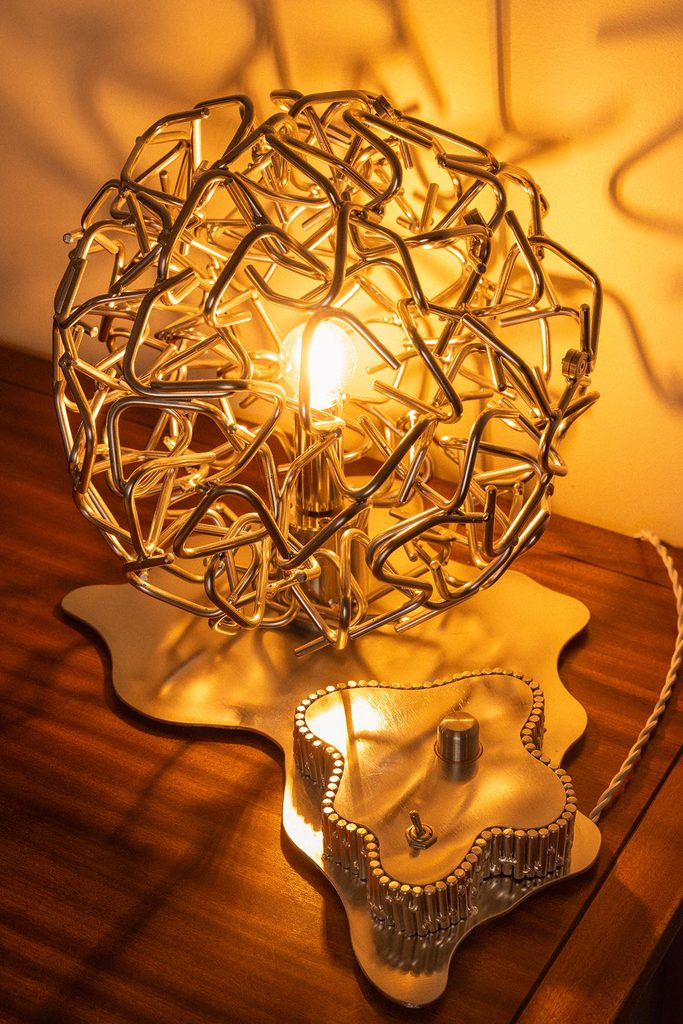
“Since making my sculpture Orb, I’ve learnt that movement brings calm. Even as we speak, my desk lamp is slowly rotating, stretching shadows across the wall. I found that research supports this too, showing that gentle movement and shifting shadows can have a calming effect on the mind,” Pat says.
“Kinetic design turns a luxury object into a functional tool for mindfulness and wellbeing. Movement can transform passive spaces into places of decompression, from a desk lamp bringing calm to a stressful workday, to a piece in a medical waiting room gently soothing an overwhelmed child,” he adds.
The larger sculpture is fabricated primarily from 10mm aluminium rod, chosen for several practical reasons. “It’s easy to bend, it absorbs light rather than reflects it, and it’s easily machined for the bearing and shaft assembly,” Pat says.
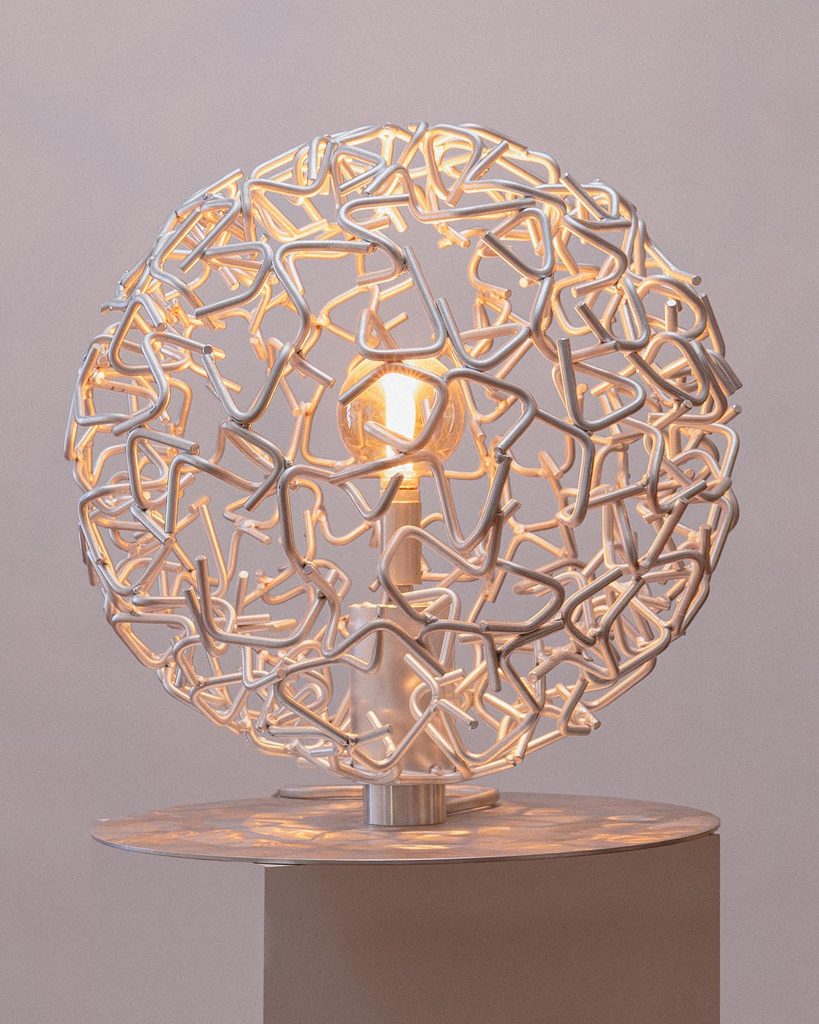
When creating the smaller version, however, the engineering became more complex. Weldable aluminium wasn’t available in the smaller diameter he required, prompting a change in material to stainless steel. As Pat explains: “The biggest technical challenge was designing the bearing assembly, as I initially thought I would need a single thrust bearing to handle the force being applied parallel to the shaft. This was going to be complex to make, and I wasn’t sure how to make it as strong.”
“My breakthrough came while installing a Ute crane, where I noticed the crane’s boom rotated smoothly on two radial bearings. I hadn’t originally thought that setup would work for my lamp and seeing it in action inspired me to adapt a similar dual radial bearing assembly, which worked perfectly!” he adds.
Even the smallest details received careful consideration; for Pat, engineering isn’t simply a means to an end, it’s an integral part of the artistic process. Every material choice supports both the movement and the experience of the finished piece.
His creative journey has also been shaped by internationally renowned kinetic artist Reuben Margolin, whose work inspired Pat long before he became a recognised designer himself. “I remember watching Reuben Margolin’s video On Kinetic Art before going to work as a fitter and turner and thinking, ‘Hmmm, I really know what I’d rather be doing,'” he laughs.
Winning Australia’s Next Top Designer has provided more than industry recognition. After years of quietly refining his craft, the award has reinforced his belief that he’s on the right path.
Today, Pat is turning that aspiration into reality. His next ambitious venture, affectionately known among friends as the ‘Big Tree Project’, promises to be his most ambitious work yet. While details remain closely guarded, it will involve several kilometres of steel rod, a significant amount of fire, and now, thanks to his ANTD prize money, the resources to bring the vision to life.
For Australia’s community of designers and makers, Flanagan’s success is a reminder that exceptional design often emerges where craftsmanship, technical skill and creative curiosity meet. His work demonstrates that engineering can evoke emotion just as powerfully as aesthetics, and that thoughtfully designed objects have the ability not only to fill a space but to change how people feel within it.
Australia’s Next Top Designer is proudly presented by Workshopped in partnership with Design Show Australia. The competition is supported by Meir Australia, Darren Palmer, Hans Galutera and Flexmirror Australia, with Axolotl supplying the winner’s trophy.